
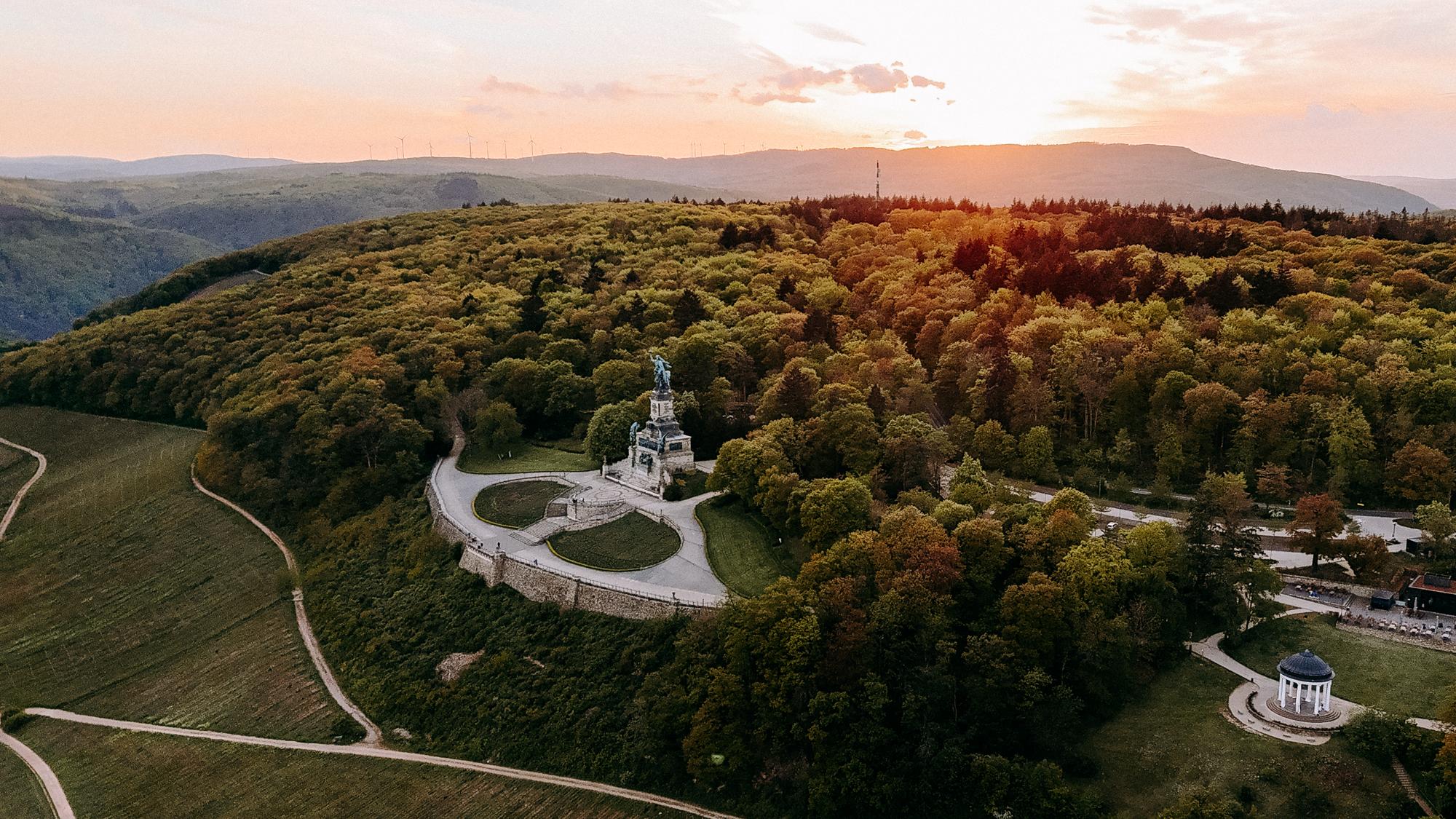
Niederwald Monument – History & Meaning
The Niederwalddenkmal is one of the most important national monuments in Germany. It commemorates the founding of the German Empire and remains a powerful symbol of unity and history.
Origins of the monument
The monument was built between 1877 and 1883.
It was created to commemorate the German victory in the Franco-Prussian War (1870/71) and the subsequent unification of Germany.
The construction took several years, as the monument was designed to stand as a lasting symbol of national unity.
The Germania statue – symbolism explained
At the center of the monument stands the Germania, an allegorical figure representing Germany.
Meaning of the elements:
- Crown → unity of the empire
- Sword → strength and defense
- Eagle shield → symbol of the German Empire
Construction & dimensions
- Height of Germania: approx. 12 meters
- Total height of the monument: approx. 38 meters
- Materials: bronze and stone
The monument was deliberately built on the Niederwald above the Rhine to ensure maximum visibility.
Tourism & early visitors
With the construction of the monument, tourism in the region began to grow rapidly. Even in the 19th century, visitors traveled to see this impressive structure. To make access easier, a cogwheel railway was built, transporting visitors through the vineyards up to the monument.
From cogwheel railway to cable car
1884: First cogwheel railway
1954: Introduction of the cable car
2005: Modern cabins
Today, the cable car itself has become a major attraction.
Meaning today
Today, the Niederwald Monument is far more than a historical structure.
It is an important symbol of German history and continues to represent the events surrounding the unification of Germany in the 19th century.
At the same time, it is part of the UNESCO World Heritage Upper Middle Rhine Valley, giving it international significance. For many visitors, it is one of the most iconic landmarks along the Rhine. The monument uniquely combines history, scenic landscapes and tourism, making it a central destination in the Rheingau region.